Comparison
Travel CRM, reservation system or travel ERP. Which one first?
What a travel CRM, a reservation system and a travel ERP each do, where they overlap, and which one a tour operator, DMC or travel agency needs first.
- Centre of the system
- The booking file
- Main users
- Reservations and operations
- Typical records
- Itineraries, services, rooming lists, confirmations
- Question it answers
- What did we sell, and is it confirmed?
Shown: Reservation system. The full table is below.
The short answer
A CRM manages the people you sell to. A reservation system manages the trip you sold: its services, suppliers, passengers and confirmations. A travel ERP joins the booking to finance and management reporting. For a business that builds its own trips the booking is the centre, so the reservation system comes first.
Side by side
Travel CRM vs Reservation system vs Travel ERP
| Travel CRM | Reservation system | Travel ERP | |
|---|---|---|---|
| Centre of the system | The client and the deal | The booking file | The whole business |
| Main users | Sales | Reservations and operations | Every department and management |
| Typical records | Leads, contacts, follow-ups, quotes sent | Itineraries, services, rooming lists, confirmations | Bookings plus invoices, payments, supplier costs, reports |
| Question it answers | Who should we call today? | What did we sell, and is it confirmed? | What did we earn on it? |
| Weak spot on its own | Knows nothing about delivery | Finance re-keys the numbers | Heavy to set up if it is generic |
Why the labels overlap
Vendors use these words loosely. Many reservation systems include client records, and many products sold as travel ERPs are reservation systems with finance added. Read past the label and ask where the booking lives, and whether the invoice and the supplier cost are produced from that same record or typed again somewhere else.
Generic CRM and ERP software
General-purpose CRM and ERP products can be adapted for travel, but they have no idea what a rooming list, a release date or a multi-destination itinerary is. Each has to be built as custom fields and workflows, and that adaptation is a project in itself. Software built for travel starts from the booking.
How to choose
Which one fits your business.
Start from what you sell, not from the software category.
A retail agency selling other companies’ products
Lead follow-up matters most. A CRM, plus access to a booking platform, covers most of the work.
A tour operator or DMC building its own trips
The booking file is the core. Start with a reservation system that also carries operations.
A growing operator with separate departments
Reservations, operations and finance need one record. Look for a system that covers all three, whatever it is called.
Enity B2B · Management and Control
Where Enity B2B sits.
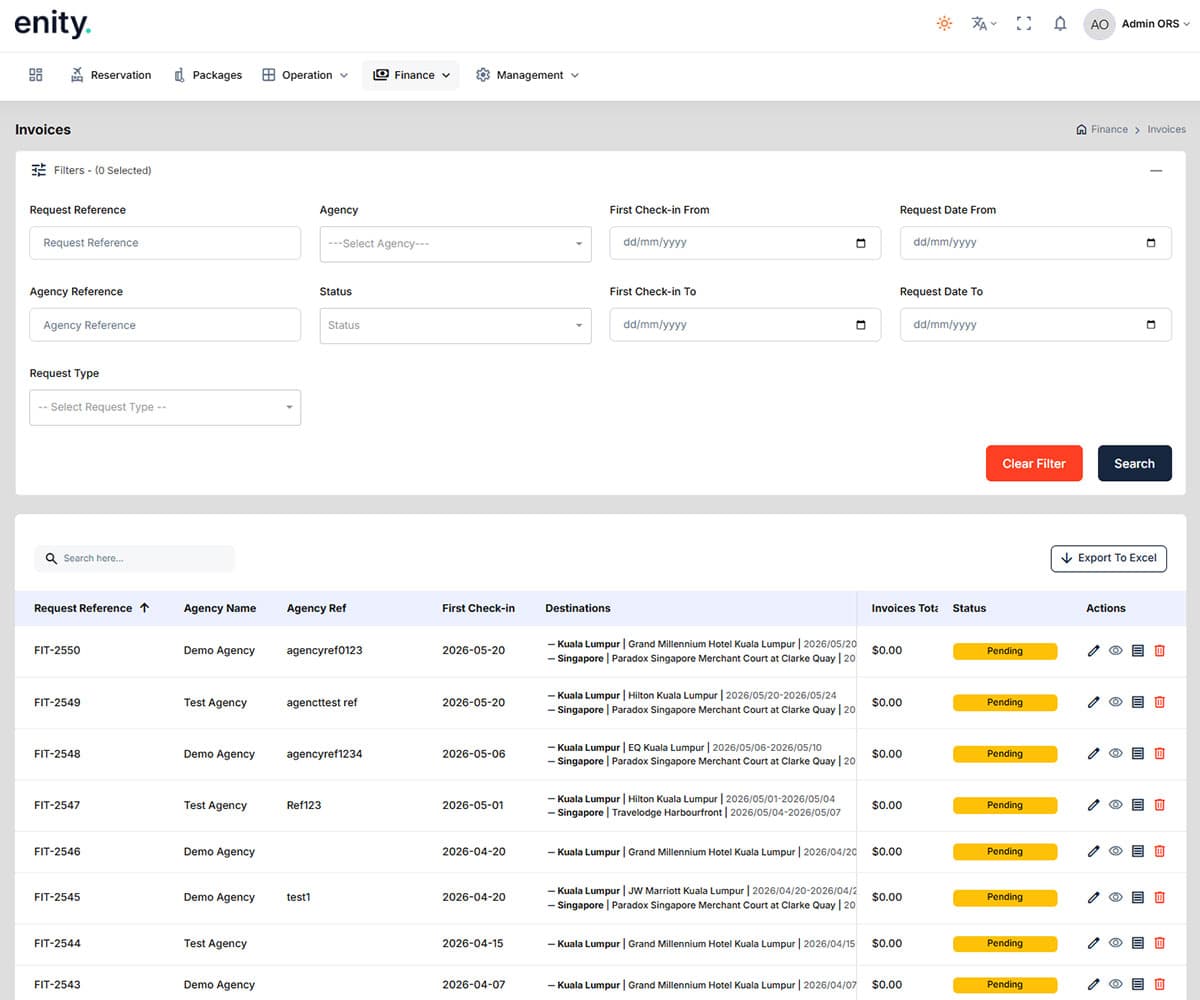
Enity B2B is a reservation management system that also covers operations, finance and management in one connected workflow. A confirmed booking is already available to operations, creates its financial record automatically, and appears on the management dashboard.
- Full visibility on every request from creation to completion
- Invoices generated automatically and linked to the booking
- Dashboard view of ongoing and completed bookings
- Role-based permissions by department, branch, or function
FAQ
Questions people ask about this.
Is a travel CRM the same as a reservation system?
No. A CRM tracks clients, leads and sales activity. A reservation system holds the booking: the itinerary, the services, the suppliers, the passengers and their confirmations. Some products include parts of both.
What is a travel ERP?
A travel ERP is software that runs the main functions of a travel business in one system: reservations, operations, finance and management reporting. The point is that a booking is entered once and every department works from it.
Does Enity B2B cover finance as well as reservations?
Yes. Enity B2B has four connected modules: reservation management, operation management, finance and accounting, and management and control. Invoices are generated from the booking, client payments and supplier settlements are tracked, and revenue, cost and margin are reported by booking, client, period or destination.
Terms used on this page
Read the definitions.
Pricing and finance
Travel back office
A travel back office is the part of a travel business, and the software behind it, that handles what happens after a sale: invoicing, client payments, supplier payments, accounting and reporting.
Reservations
On-request booking
An on-request booking is a reservation that is not confirmed at the moment it is made.
Pricing and finance
Supplier settlement
Supplier settlement is the process of checking what a travel company owes each supplier, such as hotels, transport companies and guides, against the services actually booked and delivered, and then paying it.
Book a demo and explore how.
See how your entire operation can run in one clear system.